
If you’re comparing PT school vs OT school, you’re probably drawn to a hands-on healthcare career where you help people recover, adapt, and live more independently. Physical therapy and occupational therapy overlap in some ways, but the training, daily work, and long-term career fit are not the same.
Physical therapists usually focus on movement, strength, pain, mobility, and physical function. Occupational therapists usually focus on helping people perform daily activities, such as dressing, bathing, working, studying, cooking, driving, or using adaptive tools after illness, injury, disability, or developmental challenges.
Both careers require graduate-level training, supervised clinical experience, and state licensure. Physical therapists need a Doctor of Physical Therapy (DPT) degree, while occupational therapists can enter the profession through an accredited master’s or doctoral occupational therapy program.
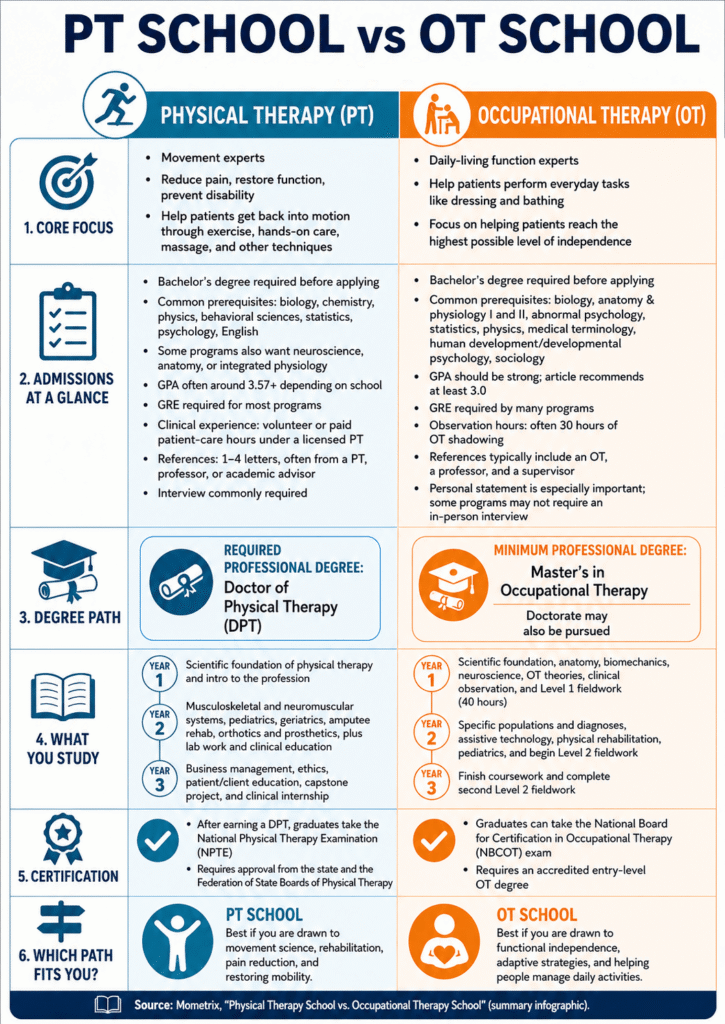
PT vs OT: The Quick Difference
The easiest way to understand the difference is this:
Physical therapy helps people move better. Occupational therapy helps people function better in daily life.
That is simplified, but useful.
A PT may help a patient regain walking ability after surgery, improve shoulder mobility after an injury, strengthen muscles after a stroke, or reduce pain through exercise and manual therapy. An OT may help a patient relearn how to dress after a stroke, modify a home for safety, build fine-motor skills, use adaptive equipment, or return to school, work, or independent living.
Both professions can work with children, adults, older adults, athletes, patients recovering from surgery, people with neurological conditions, and people managing chronic illness. The best choice depends less on which career sounds “better” and more on the type of problems you want to solve every day.
PT School vs OT School: Side-by-Side Comparison
| Category | PT School | OT School |
|---|---|---|
| Main career focus | Movement, strength, mobility, pain, injury recovery, physical function | Daily activities, independence, adaptive skills, self-care, work, school, home life |
| Entry-level degree | Doctor of Physical Therapy, or DPT | Master’s or doctoral degree in occupational therapy |
| Typical graduate program length | Often about 3 years after prerequisite coursework | Often about 2–3 years, depending on master’s vs doctoral format |
| Application service | Many students apply through PTCAS | Many students apply through OTCAS |
| Common prerequisites | Biology, anatomy, physiology, chemistry, physics, psychology, statistics | Biology, anatomy, physiology, psychology, human development, statistics, sociology, medical terminology |
| Observation/shadowing | Often required or strongly recommended; requirements vary by program | Often required or strongly recommended; requirements vary by program |
| Licensing exam | National Physical Therapy Examination, or NPTE | NBCOT certification exam |
| Licensure | Required in all states | Required in all states |
| Best fit for students interested in | Movement science, sports rehab, orthopedics, neurology, injury recovery | Independence, disability support, adaptive tools, mental health, pediatrics, daily function |
What Is Physical Therapy School?
Physical therapy school prepares students to become licensed physical therapists. In the United States, physical therapists entering the profession need a Doctor of Physical Therapy degree from an accredited program, and all states require licensure.
PT school is usually science-heavy. Students study anatomy, physiology, biomechanics, neuroscience, exercise science, pathology, clinical decision-making, and patient care. Most programs also include lab work and full-time clinical experiences where students treat patients under supervision.
PT school may be a strong fit if you are interested in:
- Human movement
- Exercise and rehabilitation
- Sports injuries
- Orthopedics
- Neurological recovery
- Strength, balance, gait, and mobility
- Helping people reduce pain and regain physical function
What Is Occupational Therapy School?
Occupational therapy school prepares students to become occupational therapists who help people participate in meaningful daily activities. Entry into the OT profession can be through either a master’s-level or doctoral-level occupational therapy program, and AOTA says there are currently no plans to require only a doctoral degree for entry.
OT school includes coursework in anatomy, neuroscience, psychology, human development, mental health, assistive technology, rehabilitation, pediatrics, adult practice, and activity analysis. OT students also complete supervised fieldwork so they can apply classroom knowledge in real patient-care settings.
OT school may be a strong fit if you are interested in:
- Helping people become more independent
- Adaptive equipment and environmental modification
- Pediatrics, schools, disability support, or aging
- Mental health and cognitive function
- Fine motor skills and daily living skills
- Supporting people at home, work, school, or in the community
PT School Admissions Requirements
Most DPT programs require applicants to complete a bachelor’s degree before beginning the professional program, although some schools offer combined or accelerated formats such as 3+3 programs.
Common PT school admissions requirements include:
- Bachelor’s degree or required pre-professional coursework
- Prerequisite courses
- Minimum GPA
- Observation or volunteer hours
- Letters of recommendation
- Personal statement or essays
- Interview, depending on the program
- GRE scores, depending on the program
Do not treat any single GPA or GRE number as universal. APTA notes that DPT programs set their own GPA requirements, and GRE policies vary by institution.
Common PT School Prerequisites
Physical therapy prerequisites vary, but many programs require courses such as:
- Biology
- Anatomy and physiology
- Chemistry
- Physics
- Psychology
- Statistics
- Exercise science or kinesiology
- English or writing-intensive coursework
Because PT prerequisites vary by school, applicants should check each program’s current requirements before building a course plan.
OT School Admissions Requirements
Occupational therapy programs also set their own admissions requirements. Many applicants complete a bachelor’s degree first, then apply to an entry-level master’s or doctoral OT program.
Common OT school admissions requirements include:
- Bachelor’s degree
- Prerequisite courses
- Minimum GPA
- OT observation or shadowing hours
- Letters of recommendation
- Personal statement
- Interview, depending on the program
- GRE scores, depending on the program
Like PT programs, OT programs vary. Some still consider GRE scores, while others no longer require them. The safest advice is simple: check each school’s official admissions page before assuming the GRE is required or optional.
Common OT School Prerequisites
Occupational therapy prerequisites often include:
- Biology
- Anatomy and physiology
- Abnormal psychology
- Developmental psychology or human development
- Statistics
- Sociology or anthropology
- Medical terminology
- Physics or kinesiology, depending on the program
OT programs may also value experience with people across different ages, disabilities, or community settings because the profession is deeply tied to daily function and participation.
Observation Hours: PT vs OT
Both PT and OT programs may require observation, shadowing, volunteer, or work experience. The exact number of hours varies widely.
For PT applicants, PTCAS advises students to check individual program requirements because programs decide whether observation hours need documentation or verification.
For OT applicants, some programs may require observation hours or signed verification forms, and applicants should confirm requirements with each program.
The practical advice: do not chase hours blindly. Get exposure in more than one setting. For PT, that might include outpatient orthopedics, inpatient rehab, sports medicine, pediatrics, or acute care. For OT, that might include schools, hospitals, hand therapy, mental health, skilled nursing, outpatient pediatrics, or community-based practice.
PT School Coursework
PT school typically moves from foundational science into clinical application.
Students may study:
- Gross anatomy
- Physiology
- Neuroscience
- Biomechanics
- Therapeutic exercise
- Musculoskeletal rehabilitation
- Neuromuscular rehabilitation
- Cardiopulmonary care
- Pharmacology
- Imaging
- Ethics
- Evidence-based practice
- Clinical decision-making
Clinical education is a major part of PT school. Students must learn how to evaluate movement, create treatment plans, document care, communicate with patients, and work as part of a healthcare team.
OT School Coursework
OT school also begins with foundational science, but the curriculum is centered on occupation, function, participation, and adaptation.
Students may study:
- Anatomy
- Neuroscience
- Human development
- Mental health
- Activity analysis
- Assistive technology
- Pediatrics
- Adult rehabilitation
- Geriatrics
- Environmental modification
- Group dynamics
- Professional reasoning
- Fieldwork preparation
- Evidence-based practice
OT coursework often asks students to think beyond the injury itself. The question is not only “What condition does this person have?” but also “What does this person need and want to do, and what is getting in the way?”
Clinical Training: PT School vs OT School
Both PT and OT students complete supervised clinical education, but the experience looks different because the professions solve different problems.
PT clinical training often focuses on movement exams, therapeutic exercise, gait training, manual therapy, balance, strength, pain, and mobility.
OT fieldwork often focuses on daily living skills, functional independence, adaptive equipment, fine motor skills, cognitive strategies, sensory processing, mental health, and environmental modification.
Both paths require professional communication, documentation, patient safety, ethical reasoning, and the ability to work with people who may be frustrated, scared, injured, or overwhelmed.
Licensure and Exams
After completing a DPT program, aspiring physical therapists must pass the National Physical Therapy Examination, and state licensure requirements are handled by individual state regulatory boards. APTA notes that it does not license PTs and does not administer the NPTE.
Occupational therapists must pass the NBCOT examination and meet state licensure requirements. AOTA states that all 50 states and the District of Columbia share the same core OT licensure requirements: graduation from an accredited OT program, supervised fieldwork, and passing the NBCOT entry-level certification exam.
PT vs OT Salary and Job Outlook
Both fields have strong employment outlooks.
According to the U.S. Bureau of Labor Statistics, the median annual wage for physical therapists was $101,020 in May 2024, and employment of physical therapists is projected to grow 11% from 2024 to 2034.
For occupational therapists, the BLS reports a median annual wage of $98,340 in May 2024, with employment projected to grow 14% from 2024 to 2034.
Salary should not be the only deciding factor. PT and OT salaries are close enough that the better decision is usually based on career fit, debt, program cost, preferred patient population, and the type of work you want to do every day.
Is PT School Harder Than OT School?
PT school and OT school are both demanding, but they are hard in different ways.
PT school may feel harder if you struggle with biomechanics, anatomy, exercise science, and physical assessment. OT school may feel harder if you struggle with psychosocial reasoning, activity analysis, mental health concepts, adaptation, and broad functional problem-solving.
A better question is: Which type of challenge fits you better?
Choose PT if you are more interested in movement, performance, physical recovery, and exercise-based rehabilitation.
Choose OT if you are more interested in independence, daily routines, disability support, adaptive strategies, and helping people participate in meaningful activities.
PT School vs OT School: Which One Should You Choose?
Choose PT school if you want to help patients improve mobility, strength, balance, pain, and physical performance. PT may be a better fit if you are drawn to sports medicine, orthopedics, neurological rehab, post-surgical rehab, or movement science.
Choose OT school if you want to help patients build or rebuild independence in daily life. OT may be a better fit if you are drawn to pediatrics, disability support, adaptive equipment, mental health, aging, hand therapy, school-based practice, or community participation.
Here is the blunt version: if you mostly care about how the body moves, look harder at PT. If you mostly care about how a person functions in real life, look harder at OT.
How to Decide Between PT and OT
Before choosing, do these five things:
- Shadow both a PT and an OT.
- Visit both outpatient and inpatient settings if possible.
- Compare tuition, debt, and program length.
- Review each program’s prerequisites before choosing your undergraduate courses.
- Ask yourself which patient problems you would still care about after a long, difficult day.
The worst way to choose is based on prestige, salary alone, or what sounds impressive to other people. The best way to choose is by getting close enough to the work that you can picture the daily reality.
Final Thoughts
The PT school vs OT school decision comes down to the kind of therapist you want to become.
Physical therapy school prepares you to help people restore movement, reduce pain, and improve physical function. Occupational therapy school prepares you to help people participate more fully in daily life, work, school, home, and community activities.
Both paths can lead to meaningful healthcare careers. The right one is the path that matches how you want to help people, how you think through problems, and what kind of patient progress motivates you most.
FAQs
Is PT school or OT school harder?
Neither is automatically harder. PT school is often more focused on movement science, biomechanics, and physical rehabilitation. OT school is often more focused on daily function, adaptation, development, mental health, and participation. The harder path depends on your strengths.
Do physical therapists make more than occupational therapists?
Physical therapists had a slightly higher median annual wage in May 2024: $101,020 for PTs compared with $98,340 for OTs, according to BLS data. The difference is small enough that career fit matters more than salary alone.
Do you need a doctorate to become a physical therapist?
Yes. Physical therapists entering the profession in the United States need a Doctor of Physical Therapy degree and must be licensed.
Do you need a doctorate to become an occupational therapist?
No, not necessarily. Entry into occupational therapy can be through a master’s or doctoral degree-level program, and AOTA states there are currently no plans to require only a doctoral degree for entry.
What is the biggest difference between PT and OT?
PT focuses more on movement, mobility, strength, and physical function. OT focuses more on helping people perform daily activities and participate in life as independently as possible.
Should I shadow both PT and OT before applying?
Yes. Shadowing both professions is one of the best ways to avoid choosing the wrong graduate path. Program requirements vary, and some schools require verified observation hours
